|
|
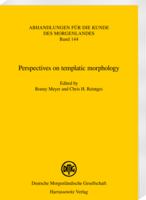
Perspectives on templatic morphology
| editor(s): | Meyer, Ronny / Reintges, Chris H. |
| series: |
|
| volume: | 144 |
| pages/dimensions: | XII, 224 Seiten, 6 fig., 47 tables |
| language: | Englisch |
| binding: | Buch (Paperback) |
| dimensions: | 14,50 × 22,00 cm |
| publishing date: | 11.02.2026 |
| prices: | ca. 55,00 Eur[D] / 56,60 Eur[A] |
| ISBN: | 978-3-447-12509-3 |
|
The collective volume explores key issues in current research on templatic morphology. This type of word formation, characterized by morphological discontinuity, relies on highly abstract form-meaning representations such as roots, vowel melodies, and derivational and inflectional prosodic patterns. Root-pattern morphology is most apparent in the Afroasiatic language phylum, especially within the Semitic language family. Because of its distinctive properties, this morphological system has long been – and continues to be – a central focus of research in phonological and morphological theory, and it is increasingly attracting attention in the related fields such as comparative syntax and syntactic theory.
Perspectives on templatic morphology comprised six contributions presenting data from Tagbaylit Berber, Maltese Arabic, Amharic, Ṭuroyo Aramaic, Coptic Egyptian, and comparative Semitic. The studies examine root-and-pattern morphology in these Afroasiatic languages from a range of empirical, theoretical, and contact-linguistic perspectives, using various methodological approaches. Together, they aim to foster cross-disciplinary dialogue and advance our understanding of templatic systems. Topics addressed include the properties of the n-stem in Tagbaylit, the relationship between non-affixal inflection and valency in Maltese, the interplay of “mediae geminatae” and weak roots in Semitic, the ongoing loss of subject agreement in Amharic, the adaptation of Arabic and Kurmanji Kurdish verbs in Ṭuroyo, and the morphology and syntax of native and borrowed adjectives in Coptic.
|