|
|
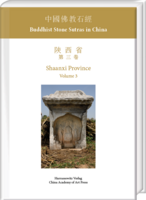
Buddhist Stone Sutras in China. Shaanxi Province
Volume 3
| editor(s): | Rong, Zhao / Sassmann, Manuel |
| series: |
|
| volume: | 3 |
| pages/dimensions: | XII, 644 pages, 397 ill. |
| language: | English |
| binding: | Book (Hardback) |
| dimensions: | 28.50 × 37.50 cm |
| publishing date: | 29.04.2026 |
| prices: | ca. 198,00 Eur[D] / 203,60 Eur[A] |
| ISBN: | 978-3-447-12515-4 |
|
more titles of the subject:
This third volume concludes the series on Buddhist stone sutras in Shaanxi Province by introducing engravings from eleven sites in the region of the Tang capital Chang’an (modern Xi’an) and beyond. In his introductory essay to this volume, Manuel Sassmann gives an overview on the rich material typology of the inscriptions, which span the dynasty’s history from the 7th to the 10th century: The texts were carved on natural cliffs, on steles of various shapes, on dhāraṇī pillars, and on assembled stone slabs to form a rare freestanding sutra wall the layout of which resembles the famous Confucian stone classics. All inscriptions at the eleven sites are contextualized, transcribed and illustrated with high-quality photographs. The documentation of accompanying historical inscriptions offers fresh insights into the circumstances surrounding particular carvings, such as those at the Xianling Shrine (639), which bears the earliest dated sutra carvings in the province, commissioned by a military official to honor the dynasty’s founder. Two further scholarly contributions engage with critical academic debates: Michael Radich examines stone-carved copies of the Heart Sutra in light of the hypothesis that this central text originated in China rather than India. Max Brandstadt’s analysis of the Master Huigong stele at Famen Monastery breaks with traditional historiography and reevaluates the ‘Three Levels Movement’ not as a rigid sect, but as a fluid network of influence. A detailed conservation report by the Shaanxi Provincial Institute for the Preservation of Cultural Heritage outlines scientific methods for protecting these valuable but porous stones. As always in this series, the texts are in Chinese and English throughout.
|