|
|
Sartori, Marina
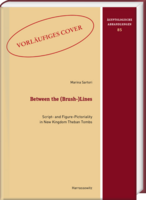
Between the (Brush-)Lines
Script- and Figure-Pictoriality in New Kingdom Theban Tombs
| series: |
|
| volume: | 85 |
| pages/dimensions: | XV |
| language: | English |
| binding: | Book (Hardback) |
| dimensions: | 17.00 × 24.00 cm |
| publishing date: | 25.11.2026 |
| prices: | ca. 148,00 Eur[D] / 152,20 Eur[A] |
| ISBN: | 978-3-447-12542-0 |
|
more titles of the subject:
In ancient Egypt, hieroglyphs and figurative paintings in elite tombs shared a profound pictorial kinship, blurring the boundaries between script and image. Marina Sartori's book investigates this dynamic relationship, revealing how artists approached and adapted iconic and also hieroglyphic material.
Detailed comparisons show that hieroglyphs could be painted with the same (or even greater) intricacy in color, detail, and iconicity as their counterparts in nearby scenes, demonstrating a fluid continuum. However, this kinship does not imply that Egyptian art is fundamentally ‘hieroglyphic’; rather, hieroglyphs were treated as vibrant pictures and not as mere linguistic signs, their visual impact often enhanced by careful detail. Based on epigraphic surveys of 21 Theban tombs, the study traces the interplay between script and figure from the harmonious unity of the 18th Dynasty, where even miniature hieroglyphs match the details of larger figures, to the divergences of the Ramessids, when writing and figurative representation increasingly diverged from each other. The scenes evolve towards a baroque ‘horror vacui’, while monumental polychrome hieroglyphs lose their significance, yielding to reduced color palettes and linear forms. Sartori emphasizes the importance of painters, who consciously manipulated these relationships and fostered innovation in color, execution, and repertoire. Richly illustrated, this work offers art historians and visual culture scholars a detailed insight into Egyptian tomb art as a site of creative visual communication shaped by the hands of ancient artists.
|