|
|
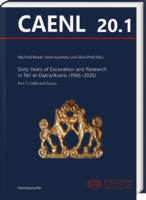
Sixty Years of Excavation and Research in Tell el-Dab‘a/Avaris (1966–2026)
Part 1: Collected Essays
| editor(s): | Bietak, Manfred / Kopetzky, Karin |
| series: |
|
| volume: | 20,1 |
| pages/dimensions: | 232 ill. |
| language: | English |
| binding: | Book (Hardback) |
| dimensions: | 21.00 × 29.70 cm |
| publishing date: | 30.12.2026 |
| prices: | ca. 128,00 Eur[D] / 131,60 Eur[A] |
| ISBN: | 978-3-447-12613-7 |
|
more titles of the subject:
From 1966 to 2026, seventy-five excavation and study campaigns at Tell el-Dab‘a/Avaris have yielded an exceptional body of evidence that will reshape aspects of the history and interactions of Egypt and the ancient Near East. Some of these discoveries are presented in this anniversary volume.
Levantine immigrants settled around a planned 12th Dynasty settlement and its harbour, establishing a trade emporium under royal patronage. Beginning around 1700 BCE, the 14th Dynasty of Near Eastern origin ruled the region and introduced Near Eastern cults, particularly that of the storm god, who was locally identified with the god Seth. The 15th Dynasty, the Hyksos, subsequently established a kingdom in northern Egypt. Their rule was ended by Ahmose, founder of the 18th Dynasty, who reunified Egypt while respecting the still-existing temple of Seth-Ba‘al. During the 18th Dynasty, under Tuthmosis III, Tell el-Dab‘a became the important harbour of Peru-nefer. A palace decorated with Minoan frescoes reflects the close relations between the Egyptian and Minoan courts. After a period of disuse, Horemheb constructed a temple to Seth on the ruins of the Ba‘al temple and laid the foundation for the Ramesside royal residence in the 19th Dynasty.
|