|
|
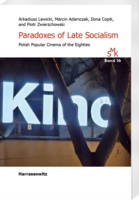
Lewicki, Arkadiusz / Adamczak, Marcin / Copik, Ilona / Zwierzchowski, Piotr
Paradoxes of Late Socialism
Polish Popular Cinema of the Eighties
| Reihe: |
|
| Bandnummer: | 16 |
| Umfang/Format: | VIII, 270 pages, 2 iil. |
| Sprache: | English |
| Ausstattung: | Book (Paperback) |
| Abmessungen: | 17.00 × 24.00 cm |
| Gewicht: | 480g |
| Erscheinungsdatum: | 11.12.2025 |
| Preise: | 58,00 Eur[D] / 59,70 Eur[A] |
| ISBN: | 978-3-447-12486-7 |
| DOI: | 10.13173/9783447124867 |
|
The image of the late Polish People’s Republic is marked by a constellation of tensions: between a difficult reality and its propagandistic representation, between the authorities and society, between rigid ideology and aspirations for freedom, and between the desire to preserve cultural continuity and the inevitability of impending change. Polish cinematography had to operate within these conditions, forced to adapt to internal transformations while at the same time becoming increasingly exposed to global cultural influences.
These and related issues are addressed in Paradoxes of Late Socialism. The discussion takes into account the political, social, economic, and cultural circumstances that shaped cinematography. The development of individual film genres is outlined, and the evolution of popular cinema in other socialist countries highlighted. The book also examines how the authorities dealt with cinema and popular culture in general. Themes such as eroticism, rock music, and retro nostalgia are explored as they appeared across popular genres and reflected the social changes of the 1980s. The final part analyzes three major narrative types – comedy, crime-action, and fantasy – to show how shifting genre conventions and social transformations are represented in these films.
|